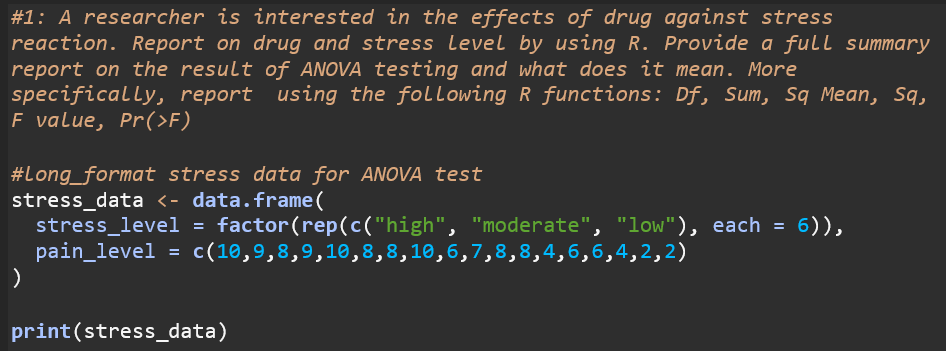
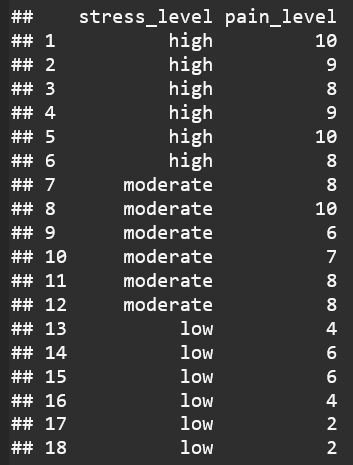
Based on this dataset:
H₀ : The drug has no effect on overall stress across stress levels (stress ratings are equal).
H₁ : The drug effects overall stress across stress levels (stress ratings are different)

Stress Df : Degrees of Freedom (Number of Groups – 1): This dataset had 3 groups, so the Df is 2
Residuals Df : Degrees of Freedom (Number of Observations – Number of Groups): This dataset had 3 groups and 18 observations, so the Df is 15
Stress Sum Sq : The amount of total variation that can be explained by the differences in stress levels
Residuals Df : Repersents that variation in reaction times that is not explained by the stress levels
Mean Sq : Calculated by dividing the sum of squares by the degrees of freedom. Average measure of variability
Stress Mean Sq : Variability explained by Stress level
Residuals Mean Sq : Variability within groups that is not explained by Stress Level
F Value : Ratio of Stress Mean Sq to the Residuals Mean Sq. F Value = 21.36
Higher F value means the variability explained by Stress levels is much larger than the variability within groups, which suggests a significant difference between groups
Pr(>F) : Probability of observing an F value as extreme as the one calculated if there were no true differences between stress levels
P value is 0.00000408 which is significant less than the typical significance level of 0.05
Low P value provides strong evidence to reject the Null Hypothesis (That there is no variability between stress levels)
The *** symbol: Confirms that the P value is in the highest significant bracket (p <0.001)
Based on the findings of the ANOVA test, the null hypothesis (H₀) can be rejected, indicating that the drug has a significant effect on reported stress across different stress levels. This suggests that the drug influences perceived stress differently depending on the level of stress.

The dataset consists of four groups of infants, each receiving different types of motor stimulation, and records their walking age (in months). The goal of the experiment was to investigate how different levels of stimulation affected the age at which infants begin to walk.
The four groups in the dataset are:
- active: Infants who received active exercise.
- passive: Infants who received passive exercise.
- none: Infants who received no stimulation.
- ctr.8w: Infants who received control treatment for 8 weeks.
Based on this dataset:
H₀ : Different Levels of Stimulation do not affect the age at which infants begin to walk.
H₁ : Different Levels of Stimulation do affect the age at which infants begin to walk.
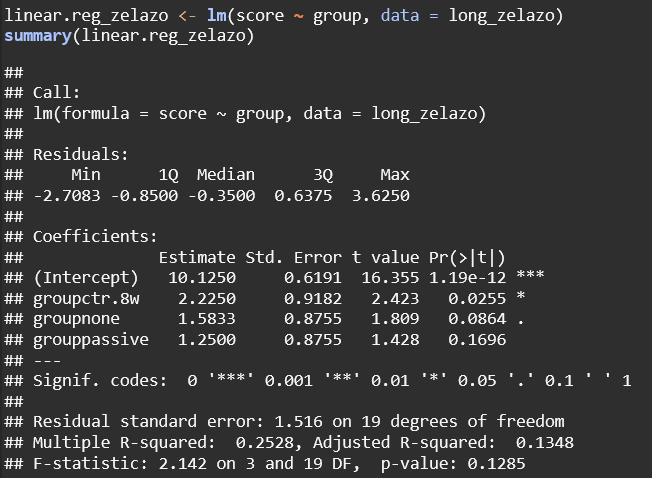
(Intercept) = the average score of the base group
groupctr.8w = The average score of the ctr.8w group is 2.225 points higher than the base group. The p value (0.0255) indicates that this is significant at the 0.05 level
groupnone = the average score of the none group is 1.583 points higher than the base group. The p value (0.0864) indicates that this is not significant at the 0.05 level, but it is significant at the 0.1 level
grouppassive = the average score of the passive group is 1.25 points higher than the base group. The p value (0.1696) indicates that this is not signficant at any level
According to the linear regression model, the ctr.8w group has a significant difference in scores compared to the active group at the 0.05 level.
The differences between the none group and the passive groups scores compared to the active group are not significant at the 0.05 level
F-Statistic: This tests if the overall model is statistically significant. The p value of 0.1285 indicates that the overall model is not statistically significant.

The ANOVA test backs up the results of the linear regression model, showing there is not a significant difference between these groups (the p value – 0.129 – is above the significance level of 0.05)

Finally, none of the pairwise comparisons are statistically significant, even after applying the Bonferroni correction.
Based on the linear regression model, ANOVA test, and pairwise t-tests, the null hypothesis cannot be rejected, indicating that the level of stimulation does not have a significant effect on the age at which infants begin to walk.
 USF Information Science Blog
Leave a comment